Daniel 1
Resolve without compromise
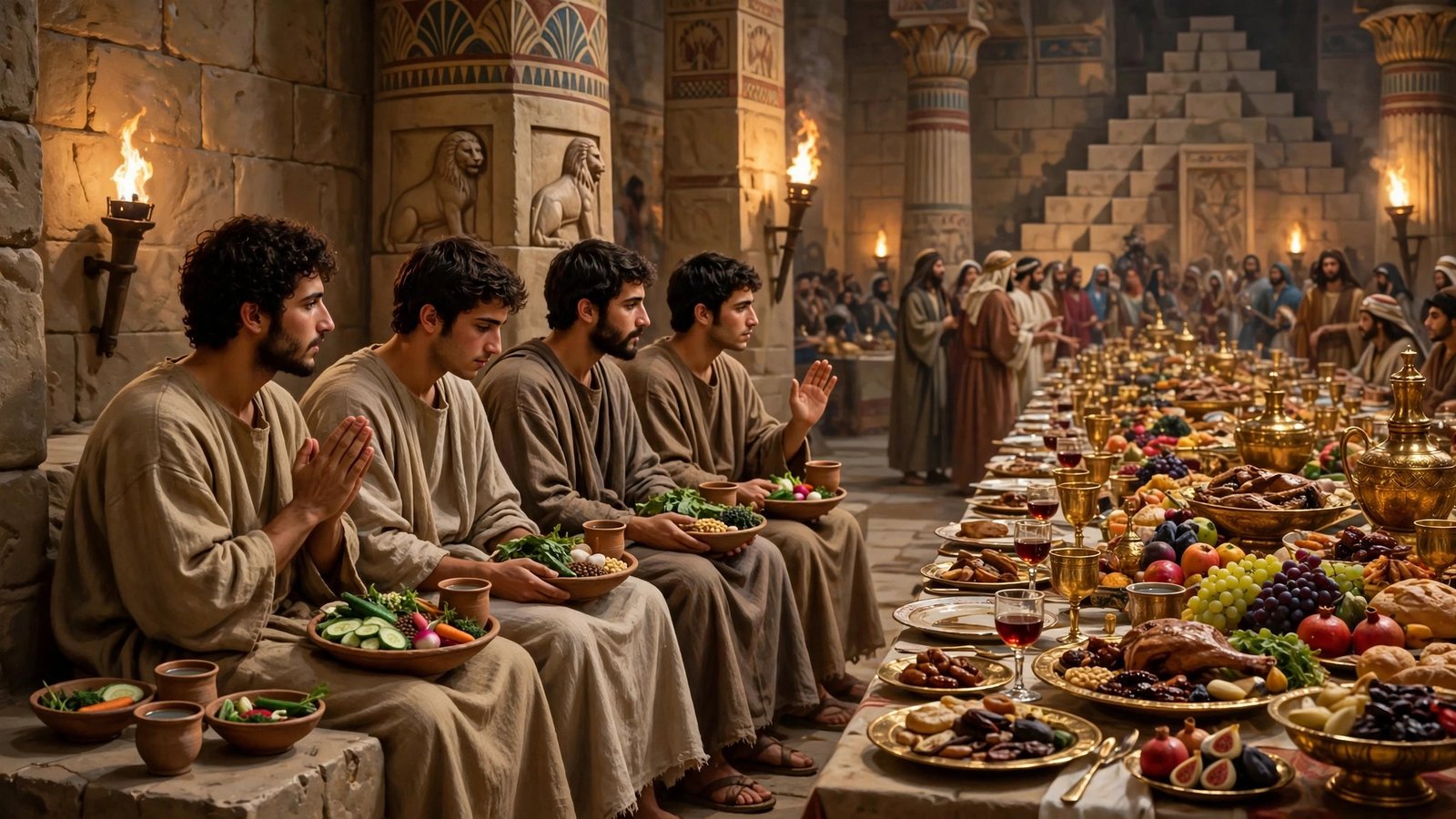
God-honoring resolve can remain gracious and faithful under cultural pressure.
Resolve without compromise

Daniel opens with Judah defeated and gifted young men carried into Babylon. Nebuchadnezzar’s program aimed to reshape their language, education, names, diet, and loyalties. Daniel did not reject every part of Babylonian life, but he drew a clear line where obedience to God was at stake. He approached the official respectfully and proposed a test rather than staging a needless confrontation.
Their names told a story
Babylon did not just rename these young men — it tried to re-god them. Every Hebrew name confessed the true God; every Babylonian name pointed to a false one.
| Hebrew name — who God is | Babylonian name — whose god |
|---|---|
| Daniel — “God is my judge” | Belteshazzar — honors Marduk (Bel) |
| Hananiah — “Yahweh is gracious” | Shadrach — Babylonian court name (exact meaning debated) |
| Mishael — “Who is like God?” | Meshach — Babylonian court name (exact meaning debated) |
| Azariah — “Yahweh is my helper” | Abednego — “servant of Nebo” |
Scholars debate the exact derivations of some Babylonian names; the identity-erasure pattern is clear.
What God says here
- Daniel 1:2Even in Jerusalem’s defeat, the chapter says the Lord remained sovereign over what Babylon received.
- Daniel 1:8Daniel resolved not to defile himself with the king’s food and wine.
- Daniel 1:9God gave Daniel favor and compassion with the chief official.
- Daniel 1:17God gave the four young men knowledge and skill; Daniel also received understanding of visions and dreams.
- Daniel 1:20The king found them far wiser than the advisers in his realm.
- Daniel 1:21Daniel remained there until the first year of King Cyrus: God sustained him through the entire exile.
Talk it through
1. What pressures were designed to reshape Daniel and his friends?
Leader notes
Their location, education, language, names, diet, and future careers were all controlled by Babylon (Daniel 1:3–7). The pressure was not merely to learn new skills but to accept a new identity and loyalty. The name changes make this concrete: each Hebrew name confessed the true God (Daniel, “God is my judge”; Hananiah, “Yahweh is gracious”; Mishael, “Who is like God?”; Azariah, “Yahweh is my helper”), while the Babylonian renames pointed to pagan gods like Marduk and Nebo — see the “Their names told a story” slide. Ask the group where similar pressures appear today. Follow-up: Where do you see this pressure or pattern in your own setting?
2. Why did Daniel accept some Babylonian training but refuse the food?
Leader notes
Daniel discerned between participation and defilement (Daniel 1:8–16). Scripture does not explain every dietary detail, so avoid inventing a reason; the point is that Daniel recognized a boundary of obedience and kept it. The food most likely raised defilement concerns under God’s law — possibly offered to idols or violating food laws — so this was about loyalty, not nutrition. Small daily choices often signal larger allegiances, and Daniel settled his before the pressure peaked. Follow-up: What part of this truth most challenges your usual response?
3. What do we learn from the way Daniel made his request?
Leader notes
He was firm about the conviction and respectful toward the official (Daniel 1:8–14). Faithfulness can be courageous without being combative, and a wise proposal can create room for obedience. Follow-up: What would one faithful action look like this week?
Talk it through
4. Where does the chapter place the source of Daniel’s success?
Leader notes
The repeated phrase is that God gave (Daniel 1:2, 9, 17). Daniel prepared and obeyed, but favor, wisdom, and insight came from God. This keeps faithful service from becoming self-congratulation. Note the bookends: 1:2 says the Lord gave Jerusalem into Babylon’s hand, and 1:21 notes Daniel was still there in Cyrus’s first year (539 BC) — God wrote both the first and last verse of the exile, sustaining His servant the whole way through. Follow-up: How should this truth change the way we pray?
5. How can Christian friends strengthen one another under pressure?
Leader notes
Daniel did not stand alone; the four young men shared the test and its consequences (Daniel 1:6–7, 11–16). Trusted believers can pray, speak honestly, and reinforce convictions before a crisis arrives. Follow-up: Who could help you live this out with courage and humility?
6. What’s one boundary the world has pushed where you had to stand your ground?
Leader notes
Invite specific but voluntary answers: honesty at work, media choices, speech, relationships, or worship (Daniel 1:8). A good application names both the boundary and a gracious way to communicate it. Follow-up: What would speaking the truth in love look like here?
This week
Daniel 1:8 (KJV) — “But Daniel purposed in his heart that he would not defile himself with the portion of the king's meat, nor with the wine which he drank: therefore he requested of the prince of the eunuchs that he might not defile himself.”
Apply it: Name one pressure point before God. Write one faithful boundary and one gracious sentence you could use if that boundary is tested. Bonus: have everyone pick the one verse of Daniel 1 they would call the key verse, then compare choices.
Lord, give us settled convictions, humble speech, wise friends, and confidence that every good gift comes from You. Help us choose obedience before pressure comes and encourage one another when it does.